I just started reading a study about the differences between LBD patients and AD (Alzheimers Dementia) related to fluctuations in cognitive abilities, particularly dysgraphia.
Right at the beginning, the authors state: “Fluctuating confusion, accompanied by disturbances of consciousness, is an important clinical symptom, with a frequency of 80%–90% in DLB[7,8] and 20% in Alzheimer’s disease.[9] In fact, in these patients, cognitive fluctuations and periods of behavioral confusion, inattention, and alternating episodes of lucidity and capable task performance have been described.[10] McKeith identified the “marked amplitude between best and worst performance” as a distinguishing feature of the fluctuations in cognition and consciousness in DLB, contrasting this with “minor day-to-day variations” that can occur in dementia of any cause.[11]”
Mr. Dewey started keeping a journal shortly after we moved to Tennessee. He wanted to keep notes on things we did so he would have something to write to his mother about. Although she died less than a year after we moved, he continued the journaling. It was never anything “deep,” or personal, but simple notes on what the weather was like, what we had to eat, activities across the day, his exercise routine. He used inexpensive, easy to find and consistent composition notebooks.
We found some use in them, like knowing when to expect the first hummingbirds to show up, frost dates, or how long it had been since I made pancakes. It was part of his routine, and he enjoyed it.
I did not notice right away that he had stopped writing in his journal in mid-May of 2017. He was still working, struggling with what we were told was generalized anxiety, for which he was taking buspirone. And I was struggling myself, after a knee replacement that was not going as well as I had hoped. In any case, the journaling stopped. He also stopped writing letters to his sister and his cousin, both of whom lived in the Minneapolis area. He said he didn’t want them to worry about them, and mostly, he didn’t want them to come visit. Their letters often included the boiler-plate “we’re thinking about coming to visit” that end up in just about everyone’s letters.
At some point John realized he was not doing any sort of handwriting. That worried him. He asked me what to do about it, and I suggested he write a letter to his cousin (his sister having died last spring). He tried, but could not get anything on the paper, and would become agitated. I purchased a couple of books: “Print Handwriting for Adults” and “List It! Activity Book for Dementia Patients.” He was initially happy to have them, and set about trying to make use of them. He will occasionally sit down with one or both of the books and spend an hour or so at them while I make dinner or bake. It’s heartbreaking to see what a struggle it is for him.
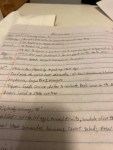
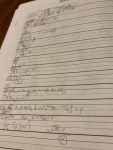
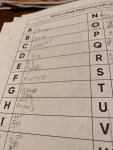
It is interesting that he is able to read with little difficulty. Sure, he may not retain what he has read, and if he does retain it, can’t recite it with any confidence, but he still enjoys reading, particularly Scientific American, National Geographic, and Smithsonian, as well as the daily paper. But all of the little things that happen between the brain and the fingertips, between the word one knows and the word one writes – those millions of little sparks fire against a protein called alpha-synuclein (Lewy Bodies) that stick themselves to his brain cells. And so, in the last three years, you see the change from the journal to the workbook. Within that workbook, on the same line, sometimes within the same word, there will be those “cognitive fluctuations and periods of behavioral confusion, inattention, and alternating episodes of lucidity and capable task performance.”
 Lewy, Dewey and me