MARGINS
I’ve been thinking a lot about some observations I’ve had of a particular set of behaviors. I see, frequently, Mr. Dewey engaging in his own life rather marginally. If I am in the kitchen, he will often stand just outside the doorway. If he sits on a chair, it is tentatively so, as if he fully expects to be told “Get Up! What do you think you’re doing?” We have a bench by the front door, for storing and putting on shoes. I often find him sitting on the edge, with a full butt-cheek off the bench. It seems as though Chucklebutt is telling him he doesn’t have permission to be there, or that he might need to “escape” at any moment. I see it as a manifestation of how his brain may perceive itself as being on the margins of the real, tangible world as it loses its connections to that world.
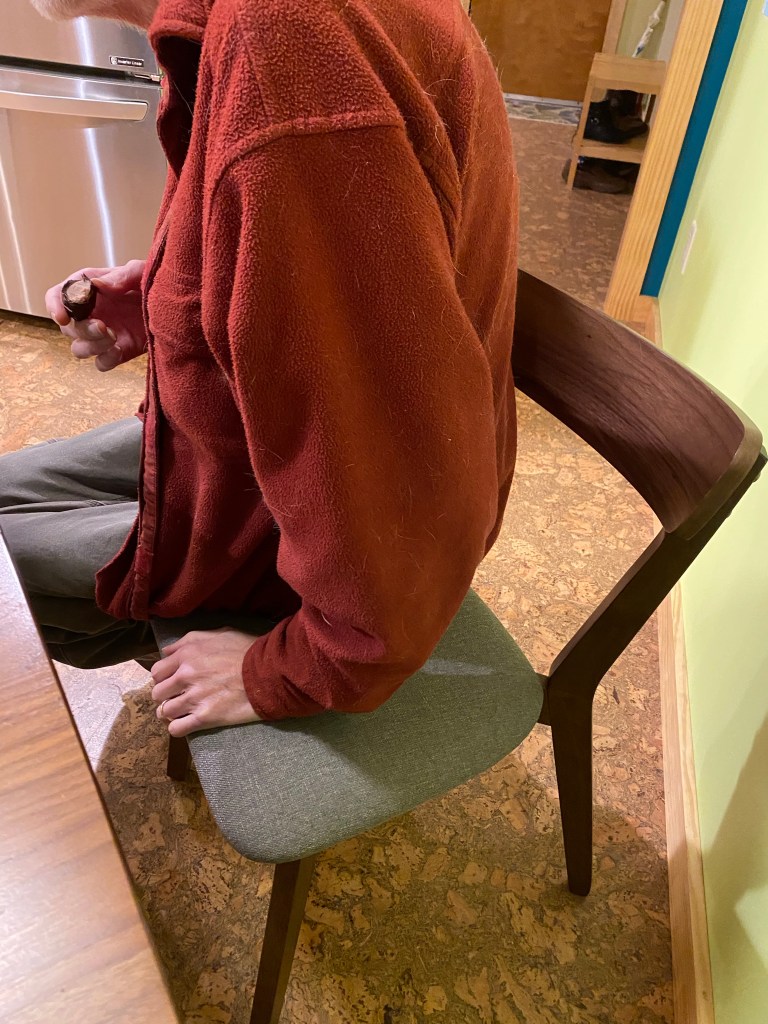
We are often told, as caregivers, not the “overcorrect.” That advice must always be weighed against his safety. These behaviors often increase the risk of falling, so I correct. Oddly, it’s difficult for him understand what I mean when I ask him to sit fully on the chair or bench, or to scoot farther onto the bed when changing clothes and such. I also worry about the impact such behavior will have on his back, which I already see bending and twisting, his shoulders unevenly positioned and pelvis cocked awkwardly.
But I see as well the psychological impact of disconnection, of drifting away. I’m not willing to let that happen yet. So I correct. And I encourage. I encourage him to connect fully with the moment, with the environment, with the activity that has him in this place and time.
It’s a lot of work for both of us.
 Lewy, Dewey and me